

Improve your triathlon running with efficient form and structured training
Triathlon Running: Learn to Run Faster
Build your running gradually, improve your form and become a stronger triathlete
Triathlon running places different demands on your body because you begin the run after swimming and cycling. Therefore, you should build your running gradually, particularly when you are starting out or returning from injury.
Running can place more impact on the body than swimming or cycling. However, a steady increase in training allows your muscles, joints and tendons to adapt. For additional injury-prevention advice, read these running injury-prevention tips from World Athletics.
Triathlon Running and the 10% Rule
The traditional 10% rule can provide a useful guide when increasing your weekly distance. However, every athlete responds differently. Therefore, monitor how your body feels and avoid increasing distance, intensity and frequency at the same time.
Running is also the most natural of the three triathlon disciplines. Although running styles differ, you can still improve your posture, rhythm and efficiency with regular practice.
For most athletes, triathlon running should focus on aerobic strength. Longer runs over rolling or hilly terrain can build this strength naturally. As a result, the terrain creates useful changes in effort without requiring hard track intervals every week.
Triathlon Running Form
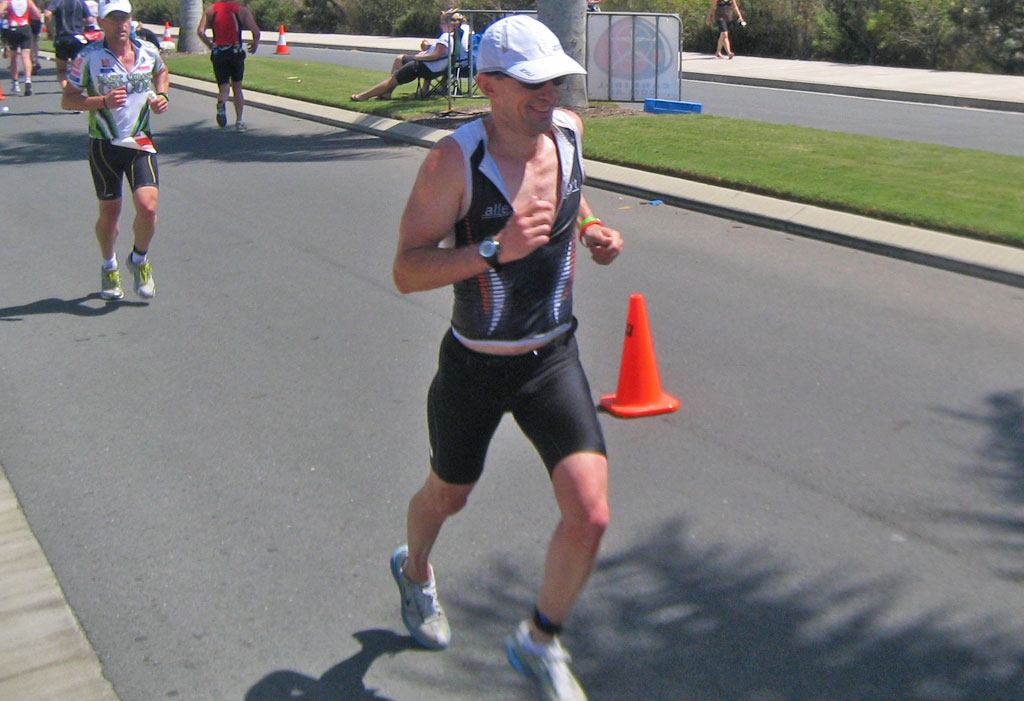
Not everyone will win a running race. Nevertheless, every athlete can learn to run more smoothly and waste less energy. Good running form helps you maintain an efficient posture while coordinating your arms and legs in one fluid motion.
The following points outline the main areas to consider when improving your triathlon running form.
Head Position
Keep your head upright rather than dropping your chin towards your chest or looking too far upwards. Consequently, your neck remains relaxed and you can breathe more freely.

Shoulders and Arms
Keep your shoulders loose and low rather than hunched near your ears. Before running, you can loosen the upper body with gentle arm circles or windmills.
Your forearms should sit at about 90 degrees to your upper arms. In addition, keep your elbows close to your body and swing your arms forwards and backwards rather than across your torso.
Torso and Hips
Run tall with your torso close to perpendicular to the ground. A large forward lean can limit leg extension, while leaning backwards can restrict forward momentum.
Instead, aim for a slight lean from the ankles. Your shoulders, hips and ankles should remain broadly aligned as your feet contact the ground.
Keep your hips directly under your torso. Generally, when your back is upright and you run tall, your hips will follow naturally.
Hands
Keep your hands relaxed. For example, rest each thumb lightly on the index finger with your palms facing one another. Imagine holding a potato crisp without breaking it or carrying sand without clenching your fists.
Feet and Foot Strike
Aim to land lightly with each step and avoid reaching too far ahead of your body. Your foot should contact the ground close to your centre of mass. Then, lift the foot away quickly rather than forcing a hard push-off through the toes.
Stride and Cadence
Use a short, light stride rather than an exaggerated one. Overstriding can slow you down because the foot lands too far in front of the body.
Likewise, aim for a quick and comfortable turnover. Many runners sit near 170 steps per minute or above; however, cadence varies between athletes. Therefore, focus first on light contact, relaxed movement and a rhythm you can maintain.
Efficient triathlon running form reduces wasted energy and helps you run strongly after the bike.
Triathlon Running Drills
Running drills have been used by coaches for generations. However, many age-group triathletes may not have practised them before, particularly if they have trained alone.
These drills can strengthen the lower legs, quadriceps, glutes and hip flexors. In addition, they improve coordination, rhythm and running reflexes.
- Use drills to isolate one part of your running technique.
- Ask a coach or training partner to observe your form where possible.
- Allow time to learn each movement and do not become discouraged.
Warm up for at least 15 minutes before completing running drills. Ideally, include them near the start of a planned run after your easy warm-up.
At first, complete only two or three repetitions of each drill. Then, gradually increase the distance to approximately 50–100 metres once a week.
The drills should feel controlled rather than exhausting. Therefore, reduce the speed or stop if your technique begins to break down.
Quick Knee Lifts
- Strengthen the lower legs, quadriceps, glutes and hip flexors.
- Take short, quick steps while lifting the knees towards waist height.
- Stay light on your feet and keep your body tall.
- Avoid long strides or rushing down the course.
- Focus on knee lift, rhythm and quick ground contact.
Kick-Out Running Drill
- Develop ankle movement and coordinated leg action.
- First, walk through the movement slowly.
- Lift the knee towards waist height and bring the heel towards the backside.
- Extend the lower leg forwards in a controlled kick.
- Finally, bring the foot down underneath the body.
Bounding Drill
- Develop quadriceps strength and forward drive.
- Spring from one foot while lifting the opposite knee.
- Remain tall and controlled while moving forwards.
- Bring the leading leg down quickly before springing from the other side.
- Keep the push-off knee slightly bent rather than fully locked.
- Start with a few bounds and gradually build towards 50–80 metres.
Triathlon Running off the Bike
Running after cycling should become part of your training as the season approaches. Initially, complete an easy transition run after a steady ride. For example, ride 30–40 kilometres and then run three to eight kilometres at a comfortable pace.
Later, you can include shorter race-specific brick sessions. After warming up, ride for five to eight minutes at a strong but controlled effort. Then, run one kilometre at a similar intensity. Repeat this sequence up to three times with three to five minutes of active recovery.
Deep-Water Running for Triathletes
Deep-water running can improve running off the bike and support triathlon running fitness with less impact. You run in the deep end of a pool without touching the bottom. A buoyancy belt can help you maintain an upright position and consistent running action.
This form of training works the hip flexors and hamstrings. Moreover, the resistance of the water can improve knee lift and muscular endurance. It can also add aerobic training while reducing impact on the legs.
Deep-water running should complement, rather than completely replace, normal running unless injury or rehabilitation requires a different approach.
Build Your Triathlon Running with a Training Program
Consistent training should lead to better results and greater enjoyment of the sport. However, the right balance of running, cycling, swimming and recovery can be difficult to manage alone.
A Multisport Consultants coach can structure your triathlon running training around your experience, goals and available time. As a result, you can build fitness steadily while preparing for the demands of race day.
So, what now? Explore our triathlon training programs. Alternatively, contact Multisport Consultants for a more personalised training program.
Latest news from Multisport Consultants
-
 16December
Noosa Ironman Training Camp
MSC crew Racing over the weekend just gone over 5 different events - In 70.3 Western Sydney – P
-
 02December
A big weekend of racing for MSC athletes
Quite a big weekend of racing for MSC athletes just passed as we hit December In Canberra at the
-
 05December
Perfect morning for a ride
Perfect morning for a ride. Last TT for 2019 and a good showing for it. Mark Preston was fastest tod